
Share VandyPrice's profile


VandyPrice
VandyPrice's stats
- Review count61
- Helpfulness votes11
- First reviewJuly 23, 2018
- Last reviewMay 26, 2023
- Featured reviews0
- Average rating4
Reviews comments
- Review comment count0
- Helpfulness votes0
- First review commentNone
- Last review commentNone
- Featured review comments0
Questions
- Question count0
- Helpfulness votes0
- First questionNone
- Last questionNone
- Featured questions0
- Answer count1
- Helpfulness votes0
- First answerFebruary 18, 2020
- Last answerFebruary 18, 2020
- Featured answers0
- Best answers0
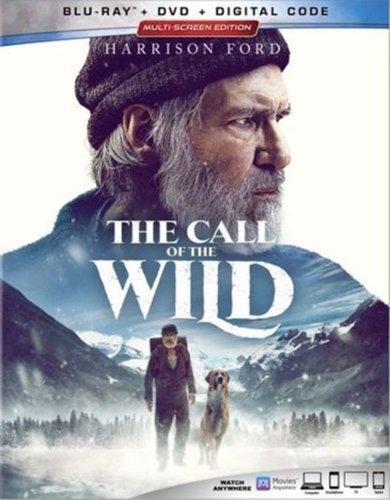
Leavening the Jack London adventure staple with striking CGI animal effects, this engaging effort follows the odyssey of Buck, the sturdy mutt stolen from his home in 1890s California and shipped to the Yukon for service as a sled dog during the Klondike Gold Rush. Rescued from an abusive owner by elderly prospector John Thornton (Harrison Ford), the two forge a bond that will be tried by unforgiving fate. Dan Stevens, Omar Sy, Karen Gillan, Bradley Whitford also star. 100 min. Widescreen; Soundtrack English. Two-disc set.
Customer Rating

3
A Boy and his Dog
on January 8, 2021
Posted by: VandyPrice
Verified Purchase:Yes
Director Chris Sanders, a man who has made his bones on animated features like Lilo & Stitch, How to Train Your Dragon and The Croods, might not seem like the first choice to adapt a novel originally published in 1903 with a story that follows a dog named Buck and contains a sentence that is described in as frank a nature as, “They closed in upon her, snarling and yelping, and she was buried, screaming with agony, beneath the bristling mass of bodies,” and yet that’s exactly where we find ourselves with this latest adaptation of the Jack London novel in 20th Century Studios’ The Call of the Wild. Though I’d never read the relatively short novel the film is based on nor had I seen either of the previous film incarnations (Clark Gable starred in a 1935 version while Rutger Hauer starred in a 1997 version) given the marketing campaign and the PG-rating I hadn’t anticipated that the source material was as brutal and unflinching as it apparently is especially when considering the fact that it’s immediately apparent that Sanders’ version of this story is one for families to enjoy and for dog/animal lovers to find the purest of entertainment in. Of course, this is mostly what I did expect from this version and so it more or less went without saying that despite much of the fuss in the run up to the release centering on the animated lead and the inherent comedy in picturing Harrison Ford acting opposite a tennis ball the fact Sanders’ background is in animation and the fact the project rung with a sense of commitment and passion for Ford more or less led to a more rewarding experience than a ridiculous one. Yes, there are still moments in which the CGI is heavily relied on and the animals look about as real as a stuffed animal, but more times than not the CGI-renderings of these wild creatures look and feel exceptionally real. This brings us to what 2020’s The Call of the Wild does well in that, despite our lead character-Buck-being a CG creation (with the help of Terry Notary), the film genuinely allows its audience to invest in Buck as a character and chart his journey as we are not only endeared to his personality, but we root for him in the sense that wherever his passions lie, we hope his strength takes him there. This, of course, is why Sanders and co. would want the freedom a CG Buck might afford them and, while likely not faithful to its source material in any true way, this Michael Green-penned adaptation conveys more a journey of growth and catharsis than it does a simple, three-act piece of family entertainment which, unlike almost everything else about the film, was completely unexpected.
Length of ownership: 59
Mobile Submission: false
I would recommend this to a friend!
Share this review:


0points
0of 0voted this as helpful.
![Tenet [SteelBook] [Includes Digital Copy] [4K Ultra HD Blu-ray/Blu-ray] [Only @ Best Buy] [2020]](https://pisces.bbystatic.com/prescaled/500/500/image2/BestBuy_US/images/products/304b2327-370a-41e7-956a-951dd4939472.png)
Customer Rating

4
Chris Nolan at His Most Chris Nolan
on January 8, 2021
Posted by: VandyPrice
Verified Purchase:Yes
“Don’t try to understand it, feel it.” This is a direct quote from Clémence Poésy’s character in writer/director Christopher Nolan’s TENET which derives its name from the Sator Square (or Rotas Square) containing a five-word Latin palindrome. The text on this square may be read top-to-bottom, bottom-to-top, left-to-right, or right-to-left; it may also be rotated 180 degrees and is still able to be read in all those ways. In the simplest of terms, this is kind of all you need to know in order to understand what Nolan is going for in his latest if not necessarily grasping how he’s meaning to achieve it. “Broad terms” is a key phrase for an initial viewing of TENET as in: it’s best to try and understand everything in broad terms. If one tries to focus too heavily on the intricacies (or the exposition, as you may have heard) it’s without doubt that one will also become overwhelmed by the complexities Nolan and his screenplay are compacting into a narrative that is not only here to serve a story or an idea, but the filmmaker that is Mr. Nolan himself. Is the film complicated? Undoubtedly, but does it make sense in those broad terms to the extent there is something for audiences to take away from the experience? Certainly. As stated, this is Nolan functioning at his most Nolan-est. John David Washington (star of BlackKklansman, son of Denzel) is our literal protagonist here (seriously, that’s the character name he’s given), but the real star of TENET is Nolan himself. The director has explored time through multiple facets throughout his filmography whether it be backwards in Memento, the extended experiences of our dreams that might amount to only a few minutes of actual sleep in Inception, the relativity and dilation of time when travelling through the stars in Interstellar as well as in the ticking clock of war in Dunkirk. Nolan has always used this element as a point of view though, as a way to better understand what his characters are going through; what the individual experience of whatever story Nolan is telling might have actually felt like. TENET is a different beast. Whereas time has always been more a factor of the plot (maybe even the antagonist, I see you Interstellar) it has never become the purpose, the cog on which the entirety of the point of the story turns. TENET is both a spy film that ultimately culminates in our hero saving the girl and the world from a bad, bad man while also being a film steeped in the fantastical idea that someone has engineered a product that allows human beings to pass both forward and backward in time. Like I said, broad terms. What’s unfortunate is that while Nolan is spinning his impressive wheels at the highest of levels and combining his strong visual and atmospheric prowess with that of truly inventive and innovative ideas (per usual) he is still unable to make us care about the people parading through these locations and ideas. In short, Poésy’s character was onto something when she said, “Feel, don’t think,” as a lack of understanding regarding the world of TENET might more easily be forgiven if there were anything to feel for any of these individuals, but Nolan’s script is so intent on generating questions over care that it’s difficult to consider much reflection once the astonishment wears off.
Length of ownership: 23
Mobile Submission: false
I would recommend this to a friend!
Share this review:


0points
0of 0voted this as helpful.
Customer Rating

5
One of the Best Films of 2019
on January 8, 2021
Posted by: VandyPrice
Verified Purchase:Yes
On the surface, Knives Out is a movie crafted in the vein of Clue or an Agatha Christie murder-mystery, but these genre constructs are only present to (mostly) serve as the conduit for writer/director Johnson to better express his feelings about, his concerns for, his frustrations with and his fears concerning America in 2019. Johnson is known for having split the Star Wars community in half with his previous film, Episode VIII - The Last Jedi, but before he took on a Star Wars movie he began his career in smaller fare like Brick before moving into bigger, but still very original features like The Brothers Bloom and Looper. Each of these films have a distinct nature in terms of the type of storytelling or genre Johnson is conveying his voice and ideas through and that is very much the case with Knives Out. When Johnson is working within a genre that allows him the room to elaborate on characters and scenarios in the way that he very clearly enjoys doing it is a formula that is almost unstoppable. Knives Out is a near-perfect film not only because it serves this allegorical purpose, but also because it can be enjoyed simply as a murder-mystery as it is wholly satisfying on just this level.
Length of ownership: 66
Mobile Submission: false
I would recommend this to a friend!
Share this review:


0points
0of 0voted this as helpful.
![The Bourne Ultimate Collection [Includes Digital Copy] [4K Ultra HD Blu-ray]](https://pisces.bbystatic.com/prescaled/500/500/image2/BestBuy_US/images/products/f2f046ed-c034-4525-b2af-55b0b4683428.jpg)
This box set contains all five films following the action-packed adventures of elite government agent Jason Bourne (Matt Damon; Jeremy Renner), an assassin determined to uncover the dark secrets of his past. Included here are The Bourne Identity, The Bourne Supremacy, The Bourne Ultimatum, The Bourne Legacy, and Jason Bourne.
Customer Rating
5
Bourne Again...on 4K
on January 8, 2021
Posted by: VandyPrice
Verified Purchase:Yes
Really nice set. Presentation is great and the 4K transfer is impeccable-especially given the handheld style of many of these films.
Length of ownership: 7
Mobile Submission: false
I would recommend this to a friend!
Share this review:


0points
0of 0voted this as helpful.
Customer Rating
3
A Disappointing Conclusion
on April 10, 2020
Posted by: VandyPrice
Verified Purchase:Yes
If one was to go back and watch the prequels ("...but why?!?" you cringe!) with as objective a perspective as possible, with the allowance of framing them in a new light given the events of the Star Wars universe that have unfolded since their release it's not hard to see that Emperor Palpatine has always played the role of puppet master; at first hedging both sides against one another before fully giving in to his true Sith tendencies and converting a young Anakin Skywalker to follow him on that path. And while J.J. Abrams initial film in this sequel trilogy, The Force Awakens, seemingly had no interest in resurrecting the long, thought-to-be dead Emperor there is sound reason (believe it or not) in bringing this antagonist back to round out all three trilogies in a way that makes for a resounding stanza...just as George Lucas always intended. It's about rhyme; a recurring metrical unit where the past predicts the future. There is a great sense of scope and history in these films and while Disney has admittedly fumbled a massive opportunity with these sequels, Star Wars: Episode IX - The Rise of Skywalker, seeks to try and rectify the lack of cohesion in this latest trilogy and bring everything together through that aforementioned scope and history in a fashion that is both meaningful to our new heroes while imparting the identity of those original heroes to inspire this new generation to continue to work towards the betterment of the galaxy. Yes, The Rise of Skywalker more or less crams two movies into one and yes, it is genuinely disappointing that this series wasn't better constructed from the beginning given how much this world means to so many people, but taken what we're given Abrams and co-writer Chris Terrio (Argo) are able to connect the dots in a satisfying enough way where the right questions are answered, some mysteries remain yet feel destined to be unraveled on Disney+ while other inquiries are made that no one seemed to be asking, but are quickly brought up and resolved just as swiftly. It's impossible to please everyone and as much as I hate to admit it as a long-time, but not die-hard fan of the franchise, the discourse around these films is often toxic and demeaning. It's okay to simply enjoy whatever brings a smile to your face and more often than not, as I sat experiencing The Rise of Skywalker for the first time, I had a smile on my face.
Length of ownership: 9
Mobile Submission: false
No, I would not recommend this to a friend.
Share this review:


0points
0of 0voted this as helpful.
![Dark Waters [Includes Digital Copy] [Blu-ray/DVD] [2019]](https://pisces.bbystatic.com/prescaled/500/500/image2/BestBuy_US/images/products/d9148114-6a74-4936-856c-55c5de459166.jpg)
Customer Rating
5
An Investigative Procedural Exception
on April 10, 2020
Posted by: VandyPrice
Verified Purchase:Yes
Director Todd Haynes has crafted a pure legal thriller that excels in every sense of the genre. While rather straightforward on the surface, Haynes utilizes this sly tactic of maintaining a low key tone and subdued visual aesthetic that, as the film builds, the power of what is unfolding sneaks up on you making the gut punch of the truth to power moments genuinely effective. Ruffalo matches Haynes beat for beat in his performance as environmental attorney Robert Bilott with the power of his performance not coming into full effect until the credits begin to roll and we realize there is no happy ending here; that the difference between justice and compensation has become a line so blurred that a company has been able to buy there way out of and continue producing and making a profit from a chemical now found in every human on the planet. A disease-causing chemical that cannot be extracted from your blood, I might add.
Dark Waters is not only compelling and exquisitely crafted, but is terrifying as hell. A true wake-up call to a nation that has subscribed to the fact everything they consume probably causes cancer in one way or another. It's a shame this will get overlooked come awards season and not because it deserves the prestige (though it does), but because it won't be afforded the publicity that would garner more interest from the average movie-goer. It's a shame more people won't see this because I haven't been able to stop thinking about it since I did.
Length of ownership: 7
Mobile Submission: false
I would recommend this to a friend!
Share this review:


0points
0of 0voted this as helpful.
Customer Rating
5
A Multi-Genre Masterpiece
on April 10, 2020
Posted by: VandyPrice
Verified Purchase:Yes
Who is rich? Who is poor? Why are some so and others not? In writer/director Joon-ho's Parasite the Kim family live in what is referred to as a "semi-basement" home in Korea. The house is essentially half above and half below ground and is a common fixture of poorer neighborhoods in the region; this space above ground representing the slight amount of hope left in the residents that they have not yet succumbed to the lowest possible level. This is not to be dismissed as a decision based purely in realism as Parasite is the type of film that builds upon its details and attaches great significance to every aspect of its execution. This slight amount of hope afforded the Kim family is manifested through opportunities gained through deceit that then become an invasion or infiltration into not only another family, but another class of family.
Parasite's calculated blend of drama, comedy, satire and unbelievable tension give way to scenarios in which the rich and poor see the same circumstances with vastly different perspectives; one recognizing what is being done to them as a con or crime while the other viewing it simply as a means to an end...survival, in other words. The director ultimately alludes to the fact that the poor-no matter the lengths of their tactics or the subtleties of their actions-still find themselves figuratively buried if not literally, by the world and by the ramifications of their actions.
Length of ownership: 7
Mobile Submission: false
I would recommend this to a friend!
Share this review:


0points
0of 0voted this as helpful.
Customer Rating
4
A Filmmaking Marvel
on April 10, 2020
Posted by: VandyPrice
Verified Purchase:Yes
At the risk of spoiling a truly grisly moment in writer/director Sam Mendes' latest film, there is an instance not fifteen minutes into the film when our protagonist, Lance Corporal Schofield (George MacKay), injures his hand on a barbed wire fence. It is not this injury that is cause for the gruesome winces 1917 is sure to induce though, but rather that moment comes a minute or so later when Schofield's mission partner, Lance Corporal Blake (Dean-Charles Chapman), knocks into him as the two hurriedly slide into a trench so as to not be spotted by enemy planes overhead. It is in this moment that occurs shortly after the film has set the stage for our expectations of what we might expect war to really feel like that it then shows us the reality of those expectations in turn aiding the audience in realizing that no amount of preparation or precedent could ever prepare one for the true nightmares that are the unspeakable things one human can subject another human to. It is in this quick, but effective moment that remained with me for the duration of the film's nearly two-hour runtime that emphasizes the power of the film in general over the would-be gimmick of the single-take experience in that not only does Mendes' and cinematographer Roger Deakins' technique provide an enticing challenge for seasoned filmmakers such as themselves, but it is in the challenge of balancing that technique with the ability to tap into something real, something raw and something that speaks to who these two men were in their souls that keeps the audience engaged. Successful or not, the technique of it all will largely go unnoticed by general moviegoers and in turn only make the immersion greater even if that general moviegoer isn't aware of what's creating said effect. Mendes and Deakins have proven time and time again they have the skill to pull off exactly what 1917 does, but for them to ultimately have the artistry to pair that craft with the character's drive to simply do the right thing in accomplishing their mission, a mission that will save hundreds of lives, while being surrounded by the ugliness of humanity on that mission is what makes the immersive quality of the single shot idea worth the trouble; the technique elevating the film to something unexpected not in that it is a dazzling technical achievement, but an emotionally involving experience with real stakes and a clear perspective.
Length of ownership: 9
Mobile Submission: false
I would recommend this to a friend!
Share this review:


0points
0of 0voted this as helpful.
Customer Rating
4
A Fitting Sequel to Both the Novel and Film
on February 18, 2020
Posted by: VandyPrice
Verified Purchase:Yes
How does one craft a forty year-later sequel to what is widely considered one of if not the greatest horror film of all time that is also based on a sequel novel by an author that didn't appreciate the aforementioned film adaptation? In other words, how does one approach making a film based on a book that is the sequel to the original source material as well as being a sequel to the film adaptation that the author of both novels didn't care for? Tricky, right? Complicated? Complex? Beyond difficult? Sure, it's all of these things and while I've not read any Stephen King in some time (we're talking probably high school) and wasn't aware the master of horror had penned a sequel to The Shining in 2013 it seems inevitable still that this is where we are six years later with the one hundred and fifty-two minute Doctor Sleep.
In the same amount of time since King's follow-up was released, writer/director Mike Flanagan burst onto the scene with a feature length adaptation of his short film, Oculus, that paved the way for him to become Netflix's go-to guy for original horror content as the filmmaker not only produced original films for the streaming service like Before I Wake and Hush, but also got his feet wet with another King adaptation in 2017's Gerald's Game then going on to oversee the wildly successful TV series, The Haunting of Hill House, that premiered to rave reviews last year. This is all to say that Flanagan has developed a style all his own and more importantly-a penchant for gauging the type of scares and imagery to best represent the horrors of a given story-meaning he's able to grasp the characters and their circumstances in a way where the scares aren't for the sake of the genre, but are in fact appropriate and even further, indicative, of the type of narrative being disclosed. Flanagan does this through soft, but illuminating character moments in which he latches onto certain aspects of an individual bound to serve a significant role in the story he's telling and then track the arc of said character trait through the more genre-specific events that naturally tend to enlighten the character to this side of themselves they may have either not previously considered or wanted to face in ways that are emotionally compelling and thematically resonant. Thus is the case with adult Danny Torrance (Ewan McGregor) in Doctor Sleep as Flanagan's now distinctive approach blends with the style of Stanley Kubrick's 1980 film and the tone of King's writing to create a well-rounded, expertly balanced yet equally effective journey that is both everything fans of the original film might have hoped for as much as it is wholly its own endeavor; a bridge between who we were meant to be, who we become and the resilience necessary to counteract the detrimental and absolve one's self of their past in order to continue to shine.
Length of ownership: 13
Mobile Submission: false
I would recommend this to a friend!
Share this review:


0points
0of 0voted this as helpful.
Customer Rating
5
Everything You Want, but Didn't Know You Needed
on January 28, 2020
Posted by: VandyPrice
Verified Purchase:Yes
I've been trying for over a week now to figure out exactly why Once Upon a Time in...Hollywood, the latest opus from auteur Quentin Tarantino, hit me the way it did. As someone who's never visited California or more specifically, Hollywood, and as someone who wasn't born until nearly two decades after the year in which the film takes place there were no personal nostalgic ties to what is very clearly a very nostalgic movie for its writer and director. I love the movies as in "the movies", sure, both for their fascinating behind the scenes processes as well as certain aspects of the business and I adore the idea of crafting this love letter to a bygone era that, in many ways, is reoccurring at this very moment even if the players are very different in the similarly circumstanced game. Any piece of work that provides insight into any aspect or era of the movie business is typically something I'm game for, granted, but even my affinity for films and television shows produced in the late fifties through to the end of the sixties is low and wouldn't justify the instinctively adoring reaction these impossibly detailed re-creations of such receive and no doubt deserve. There is plenty to like and appreciate within the massive two hour and forty-minute runtime Tarantino has assembled with his latest, but it is difficult to pinpoint what exactly it is that occurs within those (nearly) three hours that not only made me long once more for days consisting of more innocence, but also genuinely made me love what I was watching and want to remain in this world he was enchanting us with. After a week of mulling over the film though, of continuing to go back to certain scenes, countless performance moments and a hundred other facets I hadn't yet considered day after day the bigger picture came to be that it wasn't necessarily any one thing in what will from now on be referred to as OUaTiH, but more it was the effect each of these elements had on one another; the meticulous re-creation of 1969 informed and enhanced the performances of these fictional characters which were in turn heightened in the context of the film by the real-life events that Tarantino weaved through his narrative so as to create a sense of familiarity while still holding tight to the destination he's driving towards. Ultimately, this stands as one of Tarantino's best, most introspective works as it delivers the feeling one wants to leave the theater with after having experienced a Tarantino flick while the experience in and of itself is something of an unexpected and surprisingly soulful one.
Length of ownership: 48
Mobile Submission: false
I would recommend this to a friend!
Share this review:


+1point
1of 1voted this as helpful.
VandyPrice's Review Comments
VandyPrice has not submitted comments on any reviews.
VandyPrice's Questions
VandyPrice has not submitted any questions.
VandyPrice's Answers