
Share VandyPrice's profile


VandyPrice
VandyPrice's stats
- Review count61
- Helpfulness votes11
- First reviewJuly 23, 2018
- Last reviewMay 26, 2023
- Featured reviews0
- Average rating4
Reviews comments
- Review comment count0
- Helpfulness votes0
- First review commentNone
- Last review commentNone
- Featured review comments0
Questions
- Question count0
- Helpfulness votes0
- First questionNone
- Last questionNone
- Featured questions0
- Answer count1
- Helpfulness votes0
- First answerFebruary 18, 2020
- Last answerFebruary 18, 2020
- Featured answers0
- Best answers0
![Ralph Breaks the Internet [Includes Digital Copy] [Blu-ray/DVD] [2018]](https://pisces.bbystatic.com/prescaled/500/500/image2/BestBuy_US/images/products/759133de-632b-4ff1-bf05-e57f7ead6c4a.jpg)
Customer Rating

4
Wreck-It Ralph Returns!
on March 19, 2019
Posted by: VandyPrice
from Little Rock, AR, USA
Verified Purchase:Yes
Walt Disney Animation Studios is now in the stage of their resurgence that began in 2010 with Tangled and was cemented two years later with Wreck-it Ralph where they are hoping to maintain the momentum of this resurgence by beginning to produce sequels to the movies that helped solidify their name as an animation powerhouse once more; that Disney could still be Disney without Pixar. Whereas the former flourished in hand-drawn animation for years and years (obviously) the mouse house hadn't had much luck with their transition to computer animation (Chicken Little, Meet the Robinsons, and Bolt each largely failed both critically and commercially at the time of release) and in trying to re-capture the magic of their nineties hot streak with the hand-drawn Princess and the Frog in 2009 it only seemed the studio was moving backwards instead of forward. With Tangled though, things began to shift and, in many regards, the first Wreck-it Ralph was a confirmation that the Disney brand was back in full effect. Wreck-it Ralph, unlike the more traditional approach Tangled took, was a cool and hip concept that was both relevant and nostalgic, but most importantly it was an idea that-when you were a kid-would have loved to think could really be true. Like Toy Story, Wreck-It-Ralph was about what happens after the kids are done playing and characters must go on with their lives. This was all well and good and spurned a rather fantastic and inventive film about feeling insecure in the role society has assigned you and securing the confidence to break free of that mold and not only become whatever it is you aspire to be, but to gain confidence in and embracing what others might inherently assume about you. Though this wasn't exactly a stretch for the studio given it was ultimately a variation on the "be yourself" lesson countless pieces of children's entertainment have spouted, it worked well given the format. The catch was, Wreck-it Ralph told such a tight and compact story that it was difficult to imagine how directors Rich Moore and Phil Johnston would naturally extend the film into something new that felt organic and wasn't dark as all get out considering the inevitability of this arcade eventually closing and all of the games getting unplugged (which they'll have to address in the trilogy-capper, right?). And while the trailers hinted at something scarcely close to The Emoji Movie, Ralph Breaks the Internet is the rare, equally inventive sequel that strives to say something more even if what its saying gets somewhat lost in translation. Even still, the dynamite dynamic between John C. Reilly's Ralph and Sarah Silverman's Vanellope is enough to hold down the fort...or the internet.
Mobile Submission: False
I would recommend this to a friend!
Share this review:


-1point
0of 1voted this as helpful.
![Boy Erased [Includes Digital Copy] [Blu-ray] [2018]](https://pisces.bbystatic.com/prescaled/500/500/image2/BestBuy_US/images/products/304b2327-370a-41e7-956a-951dd4939472.png)
Customer Rating
4
Heart-wrenching & Inspiring
on March 19, 2019
Posted by: VandyPrice
from Little Rock, AR, USA
Verified Purchase:Yes
As someone who constantly wrestles with their faith if not necessarily the belief in a higher power, one of the lessons I've personally come to learn in life thus far is that, despite many a country songs telling you to "stand for something or you'll fall for anything," the truth of the matter is that to so deeply steep yourself in one set of beliefs is to ultimately guarantee that you'll eventually (in all likelihood) become a hypocrite. Human beings naturally evolve, we continuously experience new things, and gain greater perspectives on any number of situations all of which inform an ever-developing outlook on the world and the people that populate it. To be so stubborn as to try and categorize these present experiences and interpretations of life through the prism of a single piece of literature written over two thousand years ago only seems counter-intuitive to the abilities and intelligence God has blessed us with, not to mention a rather stressful way to frame ones existence; having to make sure what is inherently felt as right or wrong is supported by doctrine whose composers couldn't have imagined the world or society as it presently stands. There is so much clout given to these rules that outline what our behavior should be that people seem to often lose sight of that inherent voice-your conscious, God himself, whatever you want to label it-that really lets you know when something is right and when something is wrong regardless of what anyone or anything else's stance on the subject might be. That is not to say the Bible isn't helpful, of course it can be and is to millions upon billions of people across the globe, and this is not to imply there aren't certain absolutes of decency that can or should be swayed, but what is being suggested is that to commit so strongly to a single set of ideals is to also make one fear change. To fear change is to stop growing. And to stop growing is to willfully succumb to a limited or narrow view of the world. It is this conflict that Russell Crowe's Marshall Eamons, a Southern Baptist preacher living in Arkansas, faces in director Joel Edgerton's second feature, Boy Erased, when his teenage son is forcibly outed as gay.
Mobile Submission: False
I would recommend this to a friend!
Share this review:


0points
0of 0voted this as helpful.
![First Man [Includes Digital Copy] [Blu-ray/DVD] [2018]](https://pisces.bbystatic.com/prescaled/500/500/image2/BestBuy_US/images/products/2db112ad-dffb-4cfd-af13-9379a8f30eec.jpg)
Customer Rating

3
Are you rushing or are you dragging?
on March 19, 2019
Posted by: VandyPrice
from Little Rock, AR, USA
Verified Purchase:Yes
Are you rushing or are you dragging? This quote from the most famous scene of director Damien Chazelle's second feature, Whiplash, kept coming to the forefront of my mind as I sat and took in his latest project-a project that, on the surface-feels radically different from anything the guy has done before. While Chazelle has carved out his niche by making films as influenced by the music that shape them as they are the pictures that compose them the closest thing First Man has to a musical number is a tease that Neil Armstrong was a fairly good piano player and that he might have written a musical with a friend in college. Are you rushing or are you dragging though? This line of dialogue from music instructor Fletcher via J.K. Simmons reoccurred to me though, due to the fact that this time around, in his fourth feature, Chazelle couldn't quite seem to figure out what tempo he wanted to keep. That is to say, there is this grand juxtaposition in First Man between the sections in which we're fully engulfed in the development of the NASA missions and the defining of the procedures and the role Ryan Gosling's Armstrong played in these decisions and then there is the home life of Armstrong, a visually warmer, but still very cold atmosphere that this man inhabits due largely to the fact he is still grieving and dealing with the death of his young daughter-even years after she has passed away. On their own, both serve as equally compelling narratives about a man in crisis each trying to figure out how to overcome something that has both never been done before and something they've never had to deal with or ever dreamt of having to deal with before. And sometimes, when these two disparate environments if not similar situations in regards to their circumstances come together they do so in effective ways; one crossing over with the other creating a broader picture of the layers that not only played into the daily lives of these men, these engineers, these astronauts, but into the lives of their wives (both Claire Foy and Olivia Hamilton are stand-outs in two different types of supportive roles), and their families. There is a particular instance dealing in how "good" the Armstrong's once were at attending funerals as a result of the line of work Neil was in, but while certain moments feel layered and others pop due largely to the stakes at hand there is an inconsistent tone to the overall piece where many sequences dealing in the moon missions feel as if they're rushing given the sheer amount of information screenwriter Josh Singer (Spotlight) is trying to cover while the more personal, introspective moments at home tend to drag in an honest attempt to truly convey Armstrong's mental and emotional processes. Fortunately, by the end, Chazelle is able to haul his intentions over these hurtles and merge the contrasting tones to create a moment that is both visually and emotionally monumental.
Mobile Submission: False
I would recommend this to a friend!
Share this review:


0points
0of 0voted this as helpful.
Customer Rating
4
A Worthy Follow-Up, A Worthy Addition
on March 19, 2019
Posted by: VandyPrice
from Little Rock, AR, USA
Verified Purchase:Yes
The "sins of the father" idea has been played out time and time again since first making its appearance in the books of Exodus and Deuteronomy, but never has it been so deliciously executed as it is in Creed II given the poetry or, as one commentator within the film calls it, "Shakespearean" nature of one Adonis Creed (Michael B. Jordan), the son of former heavyweight world champion Apollo Creed, coming face to face with the son of Ivan Drago (Dolph Lundgren) some thirty-three years after he killed his father in what was supposed to be an exhibition match. The weight of these circumstances would certainly be hailed as nothing short of mythic to any innocent bystander filled in on the details just prior to the projector heating up and then rolling the whole of Creed II, but for anyone who has seen or been a fan of the Rocky franchise for any amount of time and has specifically basked in the glory of all that is simultaneously great and terrible about Rocky IV then it's not as difficult to see how easily Creed II could have turned into an unmitigated dumpster fire that was unable to capitalize on the great mythology of these events because it couldn't re-configure the tone. The tone of Rocky IV, while featuring Rocky's most formidable opponent and the death of his former enemy turned best friend, is somehow largely light and alarmingly disengaged from the consequences of any of the actions any of the characters take, but what it has afforded this new generation of Rocky films that take the name Creed is the opportunity to see these events through an era where sequels aren't simply cash grabs, but rather that they are taken seriously and can be exceptionally executed pieces of cinema depending on the creative team and the amount of freedom afforded them. In taking advantage of the studio who wanted to take advantage of credible filmmakers who were interested in continuing the story of Rocky Balboa, the result so far has been two films that not only revel in the training montages set to motivational music or intensely choreographed boxing matches (though they still take full advantage of these staples), but films that are also genuinely interested in chronicling the present generation and how they operate based on the influence (and sins) of those that came before them. Whereas 2015's Creed showed us Jordan's Adonis figuring out who he wanted to be and overcoming the obstacles and shadow of his father to get there, Creed II continues this development by pushing our protagonist past the point in life where his father found himself; forcing the new heavyweight champ to determine how history will define him outside of being the son of Apollo Creed.
Mobile Submission: False
I would recommend this to a friend!
Share this review:


0points
0of 0voted this as helpful.
![Ocean's 8 [Blu-ray] [2018]](https://pisces.bbystatic.com/prescaled/500/500/image2/BestBuy_US/images/products/1bf3f390-c7e1-413c-9e9f-488b3dc33b1f.jpg)
Customer Rating
3
Fun Times to be Had
on November 5, 2018
Posted by: VandyPrice
from Little Rock, AR, USA
Verified Purchase:Yes
Very early in this spin-off of director Steven Soderbergh's trilogy of movies about George Clooney's ultra-smooth, ultra-smart thief we are introduced to what is and arguably always has been the most fascinating thing about these movies not to mention heist and/or crime dramas in general. This being the fact that the type of people who find themselves in such scenarios have enough self-confidence and charisma to be able to pull-off whatever facade they wish to carry. It's not about what you may or may not be hiding on the inside or what you know about yourself that you believe everyone who sees you immediately assumes as well, but more it is utilizing your appearance, age, and swagger (or lack thereof) to allow those who see you to make those first, quick assumptions only for you to then deliver upon them so as they don't think about you again. It is an awareness of sorts that Clooney's character never fully utilized, he was always the cool guy in the nice suit, but it is almost immediately that his sister, Debbie Ocean, as played by Sandra Bullock utilizes this tool. And then she uses it again. And again. If her character's tastes weren't so expensive she could make a fine enough living as a salesperson given the way she is able to adapt to and go with whatever environment she finds herself in and whatever people she finds herself in front of, but this is a movie that is meant to both continue the Ocean's legacy while expanding on the diversification of those gender and ethnic gaps that are being actively addressed in Hollywood as of late. Whether you are in support of this or moronically opposed for one reason or another this agenda doesn't really factor into the execution of the film save for one very pointed line of dialogue that is delivered in such a fashion so as to provide reasoning if not necessarily a justification for this movie's existence. Whether this was an Ocean's movie or not though, what gives the film its pulse is this throughline idea of knowing how to interact with people by scanning them upon meeting them and figuring out what type of person they want in their life and immediately becoming that person. Bullock and a few of her co-stars are able to explore this in a few different ways, but it is mostly Bullock who presents a surprisingly layered approach to this train of thought as we see her Debbie battle with how long such a lifestyle can remain exciting as masked by intentions of justice and vengeance. It's a shame the movie itself doesn't follow through on these instincts as the movie Bullock presents us with and allows us to assume Ocean's 8 might become is far more fascinating than the fun, but ultimately derivative one it ends up being.
Mobile Submission: False
I would recommend this to a friend!
Share this review:


-1point
0of 1voted this as helpful.
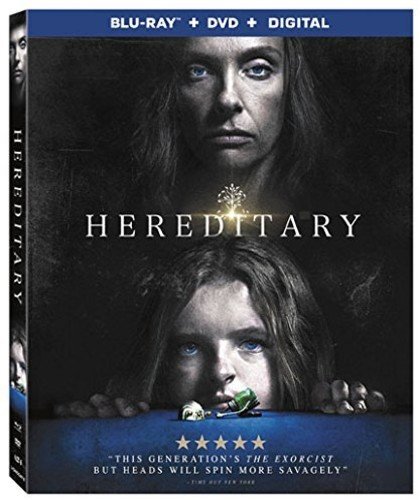
The bitter relationship between miniaturist Annie Graham (Toni Collette) and her eccentric mother had long tainted the life she built with her husband (Gabriel Byrne) and teenage kids (Alex Wolff, Milly Shapiro), and she hoped that the old woman's passing would let her move on. However, as the Grahams become enveloped in horrifying tragedy and eerie happenings, their true family legacy comes to unholy light. Genuinely chilling entry co-stars Ann Dowd, Mallory Bechtel, Zachary Arthur. 127 min. Widescreen; Soundtrack English DTS HD 5.1 Master Audio; Subtitles English (SDH), Spanish. Two-disc set.
Customer Rating
4
Solid Scares
on November 4, 2018
Posted by: VandyPrice
from Little Rock, AR, USA
Verified Purchase:Yes
It's not difficult to appreciate the craft and attention to detail in first time feature director Ari Aster's Hereditary. What is difficult to appreciate is the narrative path Hereditary follows and how much it ultimately feels patched together in order to execute horror tropes that, in all honesty, it is too good for. There is one aspect of Hereditary that feels right at home exploring the continued ramifications and deep-seated issues that are passed from one generation to the next while being more than willing to take on and explore how family can really mess you up given the most extreme of circumstances, but there is another side to the film that wants to utilize this most extreme of family dramas to paint itself definitively into the horror genre and this is where the movie kind of falls apart. The upside to this is that Hereditary only begins to really become or at least fully embrace this unnecessary narrative evolution in the last fifteen to twenty minutes or so. Prior to this, Aster shrouds so much of what is actually going on in this questionable state of what might be happening and what is actually happening by building Toni Collette and her Annie's mental state to a point where her actions are in total question of reality. We're made aware of her family history and their bouts with depression and mental health issues very early while throughout the course of the film Annie experiences incredible and unthinkable traumas that would undoubtedly bring such issues to the forefront, but while the devolving security of Annie's mental state is what ultimately brings about the true, genuine horror in Hereditary it is also this avenue, this idea of how bad parents can mess up their children that is placed on the backburner in favor of the more genre-specific plot elements. It is something of a shame it's with this familiar bang that Hereditary decides to go out as it leaves something of the wrong impression on the audience given the majority of what comes before the final revelation is an unsettling more than it is scary exercise in pacing that boils each individual party to an intentionally uneven place of uncertainty, exhaustion, and just...pure misery. Hereditary is one of those movies that is easier to admire than it is to necessarily enjoy, but it seems Aster only ever meant to paint a portrait rather than entertain a mass. It's not difficult to appreciate the camera, sound design, and especially each of the very committed performances in Hereditary, but that this twisted dysfunctional family drama ends up being more dysfunctional than it does pure family drama leaves a simplicity to be desired.
Mobile Submission: False
I would recommend this to a friend!
Share this review:


0points
0of 0voted this as helpful.
![Pitch Perfect 3 [Blu-ray/DVD] [2017]](https://pisces.bbystatic.com/prescaled/500/500/image2/BestBuy_US/images/products/e297a73e-a85a-4ae3-87d9-4e2a88f6aa14.jpg)
Customer Rating
3
A Fair End for a Fun Trilogy
on August 5, 2018
Posted by: VandyPrice
from Little Rock, AR, USA
Verified Purchase:Yes
Pitch Perfect 3 is very much a movie of its time: a safe, somewhat cautious third excursion that doesn't try to re-write the beats of the first two movies as much as it does lampoon them completely. Sometimes Pitch Perfect 3 feels like a Pitch Perfect movie and other times it doesn't, but mostly it's just an enjoyable time at the movies you won't think much about afterwards until you buy it on Blu-ray in three months to complete your collection and remind yourself of just how much carefree fun it really is.
Mobile Submission: False
I would recommend this to a friend!
Share this review:


0points
0of 0voted this as helpful.
Customer Rating

2
The Rock on Autopilot
on August 5, 2018
Posted by: VandyPrice
from Little Rock, AR, USA
Verified Purchase:Yes
Rampage is the happy meal version of a movie. It's cheap and easy and you walk away mostly satisfied even if there was no nutritional value whatsoever. It's a strange world where Dwayne "The Rock" Johnson can still be seen in theaters in his last big-budget action adventure that involves a jungle and then the first time we see the chrome-domed former wrestler in Rampage he just so happens to once again be making his way through a similar environment; it’s as if the star is guiding us out of one movie and into the next. As we are welcomed into this new world of Rampage by The Rock himself we are introduced to his Davis Okoye, a primatologist AKA someone who studies nonhuman primates, who works at the San Diego Zoo and has essentially fostered one of the last remaining albino gorillas to be his own. George, as played through motion capture not by Andy Serkis, but by Jason Liles, is a seven foot tall, five hundred plus-pound primate who can communicate with Johnson's Davis with as much ease as a deaf child might be able to communicate with their hearing enabled parent and who also has a good sense of humor about himself and his circumstances. The one thing Rampage does better than it has any right to do is develop this relationship between the two biggest stars on screen meaning Johnson is really just that good at making audiences believe he is the coolest guy around. Not everyone could make befriending a monkey cool and inspiring as opposed to the weird and off-putting looks most would get, but the guy does it; acting as if it's the most normal thing in the world and oh yeah, he was also part of an anti-poaching military force once upon a time too, so stick that in your pipe and smoke it. And sure, the fact it’s The Rock that is both this intelligent and extremely fit guy who clearly has a streak of compassion with an especially soft spot for animals is part of the appeal in Rampage as it is the ability The Rock brings along with his presence that makes a movie as ridiculous as this work as well as it does…even if it probably shouldn't. That said, and having never played the video game on which this is based, I expected the latest from director Brad Peyton (Journey 2: The Mysterious Island, San Andreas) to be a little more fun than this ends up being. Yes, there are moments of pure outrageous bliss, but they are too few and far between to make Rampage feel like the large-sized combo it was advertised to be. Rather, Rampage is drenched in that Happy Meal feeling from its quick and easy delivery to its processed if not convenient conclusion.
Mobile Submission: False
No, I would not recommend this to a friend.
Share this review:


-1point
1of 3voted this as helpful.
Customer Rating

5
An Exceptional Example of Spielberg Wonder
on August 5, 2018
Posted by: VandyPrice
from Little Rock, AR, USA
Verified Purchase:Yes
Director Steven Spielberg has a way with not only bringing the viewer into the spectacle, but making them appreciate the aura of the spectacle he has concocted on screen. We're not just in awe of what we're seeing on screen, but we're in awe of how it makes us feel. Spielberg is a master of this kind of spellbinding visual storytelling, but as the filmmaker has grown older his filmography has naturally become more serious. That is to say, it's been a decade since that fourth Indiana Jones movie and while Spielberg has co-directed a motion-capture Tintin movie here and an adaptation of The BFG there the majority of Spielberg's latter filmography consists of more "adult" projects. With his latest, Ready Player One, Spielberg returns to that era he helped define with films like Raiders of the Lost Ark, E.T. the Extra Terrestrial, Close Encounters of the Third Kind, Jurassic Park, and even Hook as Ready Player One mines the kind of wonder each of those films elicited as they were all, in some fashion, told from the point of view of a child who was allowed to run wild with and fully indulge in their imagination. Some may state that this is the very thing wrong with Ready Player One in that it is a little too indulgent in such imagination; reveling in the nostalgia of pop culture rather than relying on its own inventiveness to make it stand apart yet feel familiar. And yet, the way in which Ready Player One utilizes these aspects to tell a brand new story is so creative and so striking in its relatability-especially to an movie-goer-that it feels rooted in a truth that movies were afraid to discuss until now. It may be due to the fact that I came of age in an era where the site of that T-Rex in Jurassic Park was something that couldn't have been realized in such life-like fashion prior or because I grew up re-watching Hook to the point those lost boys became an integral part of my childhood, but the fact of the matter is Ready Player One doesn't just utilize the same tone and a barrage of references to trick audience members who might have an affection for any one of the many cameos this thing trots out in order to make them feel an affinity for this new product, but rather it takes the real world into account, advances it into a hyper, but all too probable reality, and then comments on how it's nice to indulge in our imaginations and appreciate what others have given us with theirs, but that-as with everything-balance is key and it requires real world interactions and relationships and experiences to allow those imaginations to grow. It's not a groundbreaking thesis, but it's executed so well and is such a fun journey to go on the fact its ideas aren't brand-spanking new isn't a deal-breaker. If nothing else, it's a comforting reminder told from the perspective of a filmmaker with fresh (or at least re-invigorated) eyes.
Mobile Submission: False
I would recommend this to a friend!
Share this review:


+1point
1of 1voted this as helpful.
![Paddington 2 [Blu-ray] [2017]](https://pisces.bbystatic.com/prescaled/500/500/image2/BestBuy_US/images/products/e703f582-7772-4f49-8239-b357b8f8f07a.jpg)
Customer Rating
5
This Adorable Sequel is One of the Best of '18
on July 23, 2018
Posted by: VandyPrice
from Little Rock, AR, USA
Verified Purchase:Yes
The newspaper Brendan Gleeson reads in prison is called "The Hard Times". That's how adorable this movie is.
Mobile Submission: False
I would recommend this to a friend!
Share this review:


0points
0of 0voted this as helpful.
VandyPrice's Review Comments
VandyPrice has not submitted comments on any reviews.
VandyPrice's Questions
VandyPrice has not submitted any questions.
VandyPrice's Answers