bredeker
bredeker's Stats
- Review Count72
- Helpfulness Votes64
- First ReviewFebruary 22, 2014
- Last ReviewAugust 28, 2026
- Featured Reviews0
- Average Rating4.7
Reviews Comments
- Review Comment Count0
- Helpfulness Votes0
- First Review CommentNone
- Last Review CommentNone
- Featured Review Comments0
Questions
- Question Count0
- Helpfulness Votes0
- First QuestionNone
- Last QuestionNone
- Featured Questions0
- Answer Count4
- Helpfulness Votes0
- First AnswerFebruary 22, 2014
- Last AnswerOctober 26, 2016
- Featured Answers0
- Best Answers0
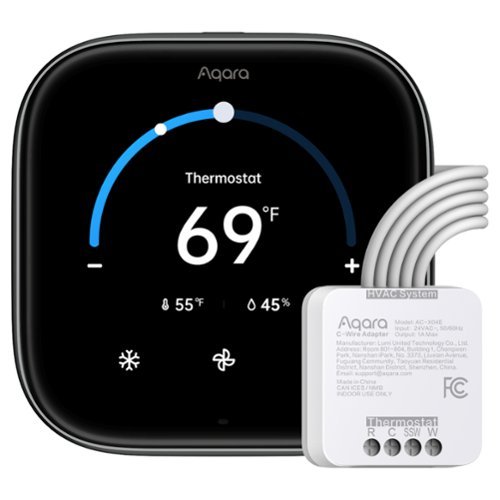
Aqara Thermostat W200, the first thermostat to support Apple Adaptive Temperature and Clean Energy Guidance, delivers effortless comfort and smarter energy savings. Your iPhone learns your routine and adjusts automatically~no schedules required. More than a thermostat, it works as a Zigbee and Thread hub with Border Router capabilities, expanding your Matter network and enabling local control across Apple, Google, Alexa, SmartThings, and Home Assistant. Built-in mmWave presence detection, dual-band Wi-Fi, security alert playback, and seamless doorbell streaming and lock control bring powerful automation together~subscription-free and designed for a future-proof smart home.
Matter thermostat with multi-sensor flexibility
Customer Rating

5.0
Posted by: bredeker
on August 28, 2026
A smart thermostat was the first investment I made into home automation, because I wanted a thermostat that supported multiple sensors in order to get a more consistent temperature throughout my home. I was sold on the utility of a multi-sensor smart thermostat, and stuck with the first brand I went with through both a move to a new house and an upgrade to a newer thermostat model. But now, I've switched to the Aqara W200, and I think it's been a great change so far.
Why the switch? Well, since installing the first smart thermostat, I have built out my smart home network with more devices. Although I now mostly prefer to use Home Assistant with Z-Wave and Zigbee, I always wished there was a better way to control the devices from other ecosystems, like Apple HomeKit and Amazon Alexa. The Matter protocol caught my attention for its "Multi-Admin" capability, which lets a device be bound to additional ecosystems - and the W200 supports Matter. It also supports additional temperature sensors, and has a familiar design because it's similar to the thermostat I'm replacing (an Ecobee Smart Thermostat Enhanced). On top of that, it's one of the first thermostats available to support the "Adaptive Temperature" feature Apple recently debuted for their HomeKit ecosystem, and I was excited to try that feature (as part of an iOS-using household).
Installation was easy in my case since I already had a "C" (blue) wire hooked up for my existing thermostat. Although not all homes may have this wire available, it has been my experience that the wire is often already run and may merely need to be connected to the terminal on the furnace control board. If you don't have the C wire available, smart thermostats often include a special adapter. The W200 is no exception, although it's worth noting that inclusion of the C-wire-adapter seems to be a feature of this specific "Matte Kit" version.
The W200 is extremely similar to the Ecobee unit I was replacing; it has a similar size, shape, and screen. The Aqara is slightly thinner and squarer. Its screen also seems to be less prone to glare and fingerprints (another benefit of this Matte version). The interfaces are also broadly similar, right down to the initial configuration: download each company's app to your smartphone, bring it near the thermostat to pair, and then follow the on-screen instructions. Once set up, both are easy to use.
Both Ecobee and Aqara offer easy Apple HomeKit integration, but this is where the first advantage of the W200 becomes evident. You'll be prompted to enable Adaptive Temperature (which you can skip and enable later). Adaptive Temperature will make HomeKit manage the thermostat setpoints more actively for you. Apple iOS users will benefit the most, as it uses your mobile device location to adjust between home and away modes automatically (Apple commits to keeping location data local to your device when using this feature). I decided to try this feature out, and - anecdotally - yeah, I think I can tell that it's returning to my preferred "home" comfort setting just before I get home. It could be simple coincidence, but I feel like our AC is more often running now right when I first walk in the door (without having to pass the thermostat first to trigger its occupancy detection).
As the first Matter-based smart home device I've used, I was also excited to try the "Multi-Admin" capability. In fact, after binding it to the Aqara app, Matter was how it integrated with HomeKit. I then also added it to my Home Assistant installation, and now it works pretty much seamlessly across all 3 ecosystems. I see no reason why I wouldn't be able to add this to even more ecosystems (like Amazon Alexa) in the future. It's not quite perfect - the ability to turn the fan on without the furnace or AC stands out as something only accessible from the Aqara app or thermostat itself, and missing via Matter. (I have seen, though not yet tried, a work-around for this online.) Nonetheless, this was the great interoperability story that I was hoping for, and I'm excited to invest more in Matter now.
I was also interested to see how far Aqara's commitment to Matter interoperability extended. I wanted to test the multi-sensor support, and what better way to do that than try a non-Aqara, Matter-based sensor? I found an inexpensive Matter temperature + humidity sensor (from a store well-known for assembly-required furniture). I also purchased another Aqara-brand Matter-based temperature sensor to compre the experience. The Aqara sensor is recognized directly by Aqara's app, but the third party sensor was still easy to set up via Matter, using the smartphone app to scan the code. I was able to link both sensors to additional ecosystems (Home Assistant and Apple HomeKit) using Matter. So far, so good.
After that, I could use the Aqara app to configure the current temperature data source for the W200 thermostat. The Aqara-brand sensor had a slight advantage here, because I could directly set it as the data source. For the third party sensor, though, you first have to create a virtual "Temperature Soft Sensor" within the app. You can then set the third party sensor as the sole input for the soft sensor, and then set that soft sensor as the W200 data source. Of course, my ultimate goal was to average the temperature from multiple locations in my house, and that requires a soft sensor as well. (You choose whether to use the minimum, maximum, or average of the sensor inputs to determine the soft sensor output.) The process might sound a bit complicated, but it actually was quite straightforward.
Competing Ecobee thermostats also support multiple sensors, but only first party ones. There's less configuration involved - you just bind a new sensor and the thermostat starts to use it. But that means there's less transparency and control over how those sensors are contributing to the thermostat logic controlling your home climate. Ecobee sensors do all include presence detection, which not all Aqara or Matter-compatible sensors will. (I believeEcobee thermostats will use presence to weight the associated sensor's contribution to the overall control algorithm.) Ecobee has walled-garden simplicity, but there's a real advantage to Aqara's flexibility and vendor-neutral Matter support.
The Aqara W200 has taken over as my favorite smart thermostat. If you also have decided that a smart thermostat is a good investment in your home's comfort, I think the Aqara W200 is a top choice - you can't go wrong with flexibility and standards-compliant interoperability. It's not substantially more complicated to set up than more vertically integrated competitors (and priced well relative to them), and offers early adopters in the Apple ecosystem support for Adaptive Temperature. Smart home enthusiasts who want to choose their own sensors or leverage Matter's Multi-Admin capability will find even more to like about the Aqara W200. It's a solid product that should be appealing to a wide range of users.
I would recommend this to a friend!
0points
0out of 0found this review helpful.
Share this review:


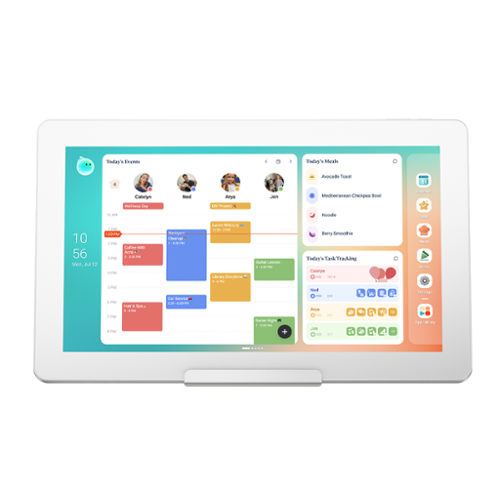
Cozyla's Digital Calendar+ 2 brings together every family member's schedules, routines, chores, and meal plans into one smart display with CalendarOS
A well-rounded, no-subscription digital calendar
Customer Rating
5.0
Posted by: bredeker
on July 30, 2026
The Cozyla Calendar Plus 2 is a digital calendar that takes, in essence, a battery-less Android tablet and adds Cozyla's custom software (apps and widgets). This model, with a 15.6-inch screen size, is the least expensive of the series. It ships with a stand for tabletop use, but also works well as a wall-mounted display. For households that want an at-a-glance family calendar, it is a strong choice - not least because it does not lock you in with a required subscription.
The biggest selling point for the Calendar Plus 2 over its competition is probably that there's no monthly or annual fee. You pay once and you're done. While the up-front cost may be a little higher for the Cozyla, it'll be more cost effective in the long run. (Cozyla recently introduced some subscription options, but has committed to giving Calendar Plus users lifetime access to the Essential tier features.) I was interested in what a digital calendar could do to help our family out as our children's schedules get busier, and I liked not being tied to a subscription. While we're definitely liking the Cozyla household-management software, it's reassuring to me that it's a lightly customized Android tablet so I can add more apps for other functionality. (For instance, I added the Home Assistant app to control my smart home devices - a perfect use for the Cozyla.)
The core household-management features are genuinely useful. You can set up separate calendars for each family member, as well as create chore and daily-task lists that track completion and stars (points) earned for completing them. I was pleasantly surprised by how well my kids took to the digital reward tracking system, who are already invested in earning stars for completing tasks in their daily routine on time. Our oldest is even already encouraging my wife to check the new calendar for upcoming events! There's also a meal-planning and recipe-management feature, though we haven't really had time to explore it much yet.
Other than the new Cozyla, we're fairly invested in the Apple ecosystem. It was a little bit of a leap of faith, but I'm pleased to say the iCloud calendar integration is better than I expected. I don't need to link an Apple account for each family member, as long as we're using shared calendars - the Cozyla can find them all through my linked account, and then I can actually assign each calendar to a family member on the Cozyla. I was glad to see an option to have external calendars use their own defined color instead of the designated color for the family member they're assigned to (which is the other option). This is very welcome because we can see the colors we're used to seeing on our other devices. That attention to consistency matters when you're relying on this device to be the visual hub of your household's scheduling. I do wish there was support for syncing other data (for instance, tasks with iCloud Reminders).
While I appreciate that the 15.6" model comes with a heavy, well-built stand for tabletop use, I was a little disappointed that it didn't also include a wall mount since that was our preferred set-up. It does support standard 100mm VESA mounts, so you're not stuck getting one from Cozyla. I opted to 3D print my own, but if that's not an option for you, remember to buy a wall mount if that's how you think you'll prefer to use the Cozyla. The 15.6-inch screen size feels large enough to explore the features comfortably without dominating a small space. It's also not terribly intrusive if you're not committed to the idea of a larger digital calendar dominating a wall with its presence.
I encountered a few hiccups in the set-up process. The biggest one was that it refused to recognize that my Internet connection was working, despite being connected to Wi-Fi. I had to resort to the offline set-up option, and thankfully the Internet connection worked just fine once I completed it that way. This didn't end up being a show-stopper but could be a bit scary or frustrating for a non-technical user.
I also couldn't find a way to set up a Cozyla account through a web browser. The only path to creating an account was through the mobile app. The Cozyla website lets you create accounts for both the Cozyla e-shop and "portal," but neither of those works for the app. It would be nice to have a unified experience and be able to manage the Cozyla from a desktop browser.
Once you're past initial set-up, I'd say the product largely leaves you to discover its household features on your own. There aren't clear guided workflows for getting the most out of the home management features. A bit more onboarding or documentation would go a long way here. There is a community of users, though, and you can find plenty of Cozyla-specific advice by searching the Web.
All in all, the Cozyla Calendar+ 2 is a worthwhile option if you want a family calendar without the burden of a subscription. The no-fee model, solid 15.6-inch display, useful core features, and iCloud integration make it a compelling choice for households that value simplicity. The setup experience wasn't perfectly polished, and a unified Cozyla account system would be nice. However, after clearing those hurdles, the Cozyla is delivering on its promise. I would happily recommend it to anyone interested in a central digital calendar system for their home.
I would recommend this to a friend!
0points
0out of 0found this review helpful.
Share this review:


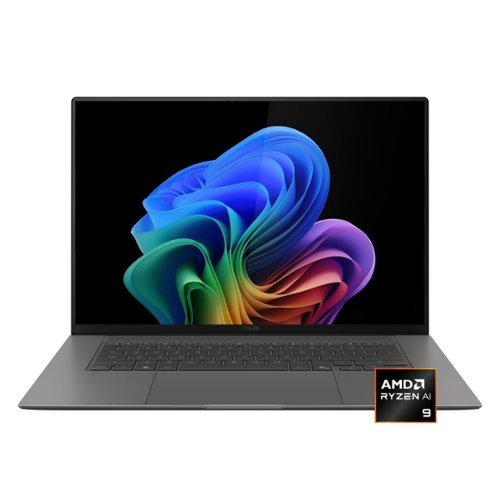
The Zenbook S16 harmoniously blends beauty and performance. Featuring an impossibly thin 0.51-inch profile crafted from premium Ceraluminum, the Zenbook S16 exudes elegance through meticulous craftsmanship. Immerse your senses in its breathtaking 16-inch 3K 120Hz OLED ASUS Lumina display and experience rich, high-fidelity audio from a powerful six-speaker system. Optimized for productivity, the Zenbook S16 is powered by an AMD Ryzen AI 9 465 processor with up to 50 TOPS to accelerate local AI workloads, while a dedicated Copilot AI Assistant key streamlines your workflow. Despite its compact form and powerful performance, the Zenbook S16 delivers exceptional battery life with its high-capacity 83Wh battery.
Exceptional screen and build quality, decent perfo
Customer Rating

4.0
Posted by: bredeker
on May 26, 2026
This laptop is, on the whole, a good computer. It justifies its premium positioning in the ASUS Zenbook line with an exceptional screen and build quality. But it also comes up a bit short of perfection in a few areas. Depending on what you're looking for, those may be enough to consider another model.
The Zenbook S16 feels great to handle and looks fantastic due to its high-resolution OLED display. The laptop is light for its performance class and features quite a thin profile. Nonetheless, it feels very solidly and rigidly built. It features a special "Ceraluminum" finish that really is pleasant. This finish doesn't readily show fingerprints, feels nice to the touch, and seems durable (not that I risked scratching it much to intentionally find out). Of course, once you turn the computer on, then you're greeted with a great OLED display. It's high resolution and supports a 120 Hz refresh rate. Although I think the default color profile looks pretty good, the included MyASUS utility can adjust the color profile to several different standards, like sRGB or Display P3.
Speaking of the MyASUS utility, it's one of the few applications ASUS preinstalls. ASUS did well to keep the preinstalled set of applications light. There's no slew of out-of-the-box bloatware to ruin the premium experience. The aforementioned MyASUS utility is genuinely useful for tweaking a lot of hardware options. There are only a few other programs. I don't really find much use for the other utilities (like GlideX and ScreenXpert), and they can be uninstalled without any hassle.
The system performance is generally good, but not exceptional. I have been using a Zenbook (non-S) 14 with a previous-gen Intel Core Ultra CPU (285H), and this system feels broadly comparable in both performance and battery life - no better, no worse. I can't say I noticed poor performance in by any means, but I was hoping to feel some benefit from the generation-newer AMD Zen CPU. The latest Core 9 Ultra CPUs seem to benchmark slightly ahead of the Ryzen 9 AI CPU included in this laptop, and Qualcomm's Snapdragon X2 seems to be besting both the Core Ultra and Ryzen AI offerings. (Luckily, ASUS offers Intel and Qualcomm Zenbook models as well, albeit with no 16" Intel version. If you're tempted by a different processor, I think one of the S16's Zenbook siblings would still be an excellent choice.)
One weak area of performance is the SSD. Although it's PCIe Gen 4, it is nowhere close to maximizing out that bandwidth. My S16 reports that a Sandisk SN5100S is installed, but it seems this is a lower-spec OEM version of the SN5100 since it doesn't match public benchmarks for the latter. At least it's a brand-name component from a reliable manufacturer, and probably sufficient for most users. It's also likely to be upgradable without too much trouble, and so given recent NAND pricing, it's probably an acceptable corner to cut to keep the price down.
On a very subjective note, I find the Zenbook S16 keyboard to be pretty good. It's not the absolute best laptop keyboard I've used, but it's not far off either. The trackpad, on the other hand, I find to be a marked step down from the one on my older Zenbook 14. I find it more difficult to click with (a physical click, not a tap). It is significantly larger, which perhaps contributes to mushy clicking. The port selection is good. The USB-C ports support USB4 (not full Thunderbolt 4), which is fine. I would have preferred at least one USB-C port on each side of the laptop (rather than both on a single side) for more flexibility when docking or charging.
In the end, I think the big question for any review is, would I recommend it? For this particular Zenbook model, I wouldn't hesitate to recommend it if you specifically want a Windows laptop with a larger screen and the greatest compatibility (which an ARM model might struggle with). Don't get me wrong; even if that doesn't perfectly describe you, you'll likely be satisfied with this computer. But keep in mind that the Intel-based Zenbook S14 may be a slightly better-performing choice if you don't mind a smaller screen, and the Zenbook A models should now be available with Snapdragon X2 if you are comfortable with a faster, ARM-based alternative.
P.S. For anyone curious, this laptop currently has some issues with booting into Linux. That is what I prefer to run on my Zenbook 14 now, and it works great, so hopefully in time the Zenbook S16-specific issues will get ironed out. The main problem seems to be with initialization of the built-in display.
I would recommend this to a friend!
+1point
1out of 1found this review helpful.
Share this review:


ASUS - Zenbook 14 14" FHD+ OLED Touch Screen Laptop - Intel Core Ultra 9 - 32GB RAM - 1TB SSD - Jasper Gray
Go the extra mile with the remarkably sleek Zenbook 14 ~ the ultimate ultraportable laptop that takes sophistication to a whole new level. Seize every moment using its enhanced extended-life battery, amplify your efficiency with an Intel Core Ultra 9 processor (Series 2) and Intel Arc GPU and find seamless connectivity with full I/O ports. Immerse your senses in its vivid Lumina OLED touch display and powerful super-linear speakers.
Good performance + battery life, great portability
Customer Rating
5.0
Posted by: bredeker
on May 18, 2025
This Zenbook notebook pairs one of Intel's most powerful laptop CPUs with an impressively sleek yet sturdy design. This particular model isn't the top spec in every regard, but I like the component choices Asus made for it. After using it for about a week, I have nothing significant to really criticize.
Right away, this computer made a favorable impression. It's not the thinnest laptop I've used, but is easy to handle and very light. Nonetheless, the build quality seems solid and it feels like it's made out of premium materials. The port selection is good; I appreciate the inclusion of USB type-A and HDMI, even though I'm satisfied using adapters with USB type-C ports. The included power adapter has a permanently attached USB cable (if adapters are going to use USB PD, I appreciate a separate cable that can be replaced) but that is inconsequential.
On first start-up, I noticed how nice the OLED screen looked. This is the first laptop I've used with OLED, and it really does look nice. Although Asus has a 120 Hz 3K OLED screen as the top-spec option for these Zenbooks, I find 60 Hz and the 1920x1200 resolution of this model to be perfectly adequate. In fact, the pixel density is pretty much perfect for me, just as it is. The trackpad feels good and works well. I also really like the feel of the keyboard - I think I would rate it as one of the top two or three laptop keyboards that I've used.
Commendably, Asus has not saddled this with a bunch of software bloat out of the box. The Zenbook had a very clean experience, with the only "extra" I noticed by the MyASUS application. And even that application has uses beyond running factory diagnostics and downloading drivers. It exposes some useful settings, like an optional Battery Care mode that smartly limits charging to 80% to extend the lifespan if you frequently keep the laptop plugged in. (I've become a fan of such features, especially when they easily allow charging to 100% when you'll need to work off battery for an extended time.)
Speaking of battery life, this laptop has markedly improved battery runtime compared to the last Intel-based laptop I used. I think this is mostly due to the power efficiency improvements Intel has made than the size of the battery. Having heavily used an ARM-based laptop over the last year, I can't quite call the battery life "impressive," but it's certainly still very good (and with an Intel CPU, this laptop won't suffer from the various minor software incompatibilities I've noticed over time with Windows on ARM).
The performance is very good, as it should be with a Core 9-designated CPU. Everything has felt snappy. The extra RAM on this particular model doesn't hurt to have, either. (As a software developer, I appreciate having more memory.) Although I haven't noticed it to be a drag on the system, I did observe that the included SSD's benchmarked speeds fall short of the best Gen 4 drives. Luckily, the NVMe drive on this model is replaceable if I eventually feel the need to have a faster one. The integrated Arc GPU is a significant improvement for Intel chips and can capably handle some light gaming. Intel did not include an NPU that meets Microsoft's requirements for the Copilot+ AI features in the chip used in this Zenbook, but all the regular AI features of Windows 11 are supported just fine.
All-in-all, this is a good computer, and I would recommend it for most people. For people after the absolute best battery life, I think an ARM (Snapdragon X) laptop will serve better. Gamers may not be satisfied with the integrated GPU, as much improved as it is. Other than those use cases, though, I don't think this Zenbook model would disappoint anyone that values a highly portable computer with plenty of power for productivity tasks, or a beautiful OLED display for media consumption.
I would recommend this to a friend!
0points
0out of 0found this review helpful.
Share this review:


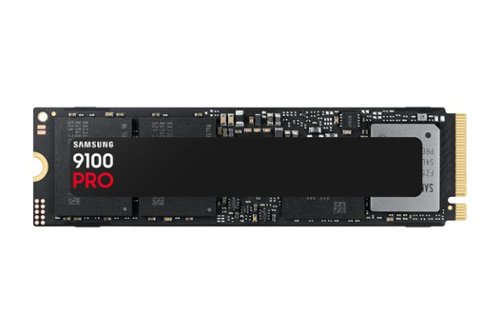
Blazing speed meets massive capacity built for AI and beyond. The Samsung 9100 PRO SSD delivers up to twice the speed of the 990 PRO SSD and up to an 8TB storage option, ensuring you have lightning fast speed and ample space for AI projects, 4K/8K video editing, gaming marathons, and more. Designed for next gen performance, it's the ultimate storage solution for your digital life.
Fast Gen5 speed and good thermal performance
Customer Rating
5.0
Posted by: bredeker
on May 6, 2025
Images for this Review
(click to see full-size image)

When I built my AMD AM5-based desktop, I stuck with a PCIe Gen 4 NVMe SSD because the (few) available Gen 5 SSDs struck me as expensive and unrefined. Samsung's 9100 Pro, however, really takes advantage of PCIe 5.0 and widens the performance gap over the best Gen 4 drives. On top of the raw performance, Samsung's touted power efficiency made this a compelling time to make the leap to Gen 5. And so far, this drive has impressively lived up to its claims.
Installation was as routine as would be expected for a 2280 M.2 drive. I made sure the thermal pad on my motherboard's heatsink was going to make contact with the visible metal heat spreader on the connector end of the drive. Thermal performance has been great so far - the SSD temperature is matching the temps that I was getting with the Gen 4 SSD I was using previously in the same slot. I was also very happy to see benchmarks indicating that I'm getting the advertised performance out of the drive - no bottlenecks or system issues to troubleshoot. For anyone interested, CrystalDiskMark hit 14,704 MB/s reading (99% of the quoted read performance) and 13,493 MB/s writing (which slightly exceeds the quoted write performance). These numbers are exactly double what CrystalDiskMark rated my Gen 4 SSD at.
I haven't owned this drive long enough to comment on its long-term reliability, but Samsung is about as trustworthy a name as there is in SSDs so I am optimistic this SSD will last a long time.
Although Gen 5 SSDs still command a bit of a price premium, the speed improvement is harder than ever to ignore if your computer has a PCIe 5.0 NVMe interface. With the Samsung 9100 Pro, I have now doubled my SSD performance without worsening my PC's thermal performance, and that makes it a worthwhile upgrade in my book.
I would recommend this to a friend!
0points
0out of 0found this review helpful.
Share this review:


Shark Steam Pickup 3-in-1 Steam Mop picks up debris, deep scrubs, & steam sanitizes~all at once. Captures & separates wet and dry debris within the nozzle, no pre-sweep needed. 2X better stain cleaning~ vs. traditional steam mops. Eliminates 99.9% of common household bacteria* with chemical-free sanitization. Use on all sealed hard floors (hardwood, tile, marble & more). Features a self-cleaning brushroll that continuously clears itself of dirt and grime without spreading the mess, so you never have to clean with a dirty pad again! ~Based on IEC IEC/TC SC 59F (MUSTARD), tested against S1000. *To sanitize floors, follow the product~s directions for use in the Owner~s Guide completely. Sanitization studies were conducted under controlled test conditions. See the Owner~s Guide for details on testing
Easy and effective
Customer Rating
5.0
Posted by: bredeker
on October 20, 2024
This Shark steam mop is simple to assemble and use. It's compact, and needs less than half a minute to warm up and start producing steam. It comes with a small stand to hold it when you're not using it. The water reservoir is not huge, but it was still sufficiently large for us to do a few rooms before refilling.
This is the first steam mop I've used, so I cannot speak to its performance relative to competitors. However, it seems to work just as I well as I could have hoped. With two young kids, it's common for us to have little sticky spots where drips happened, and this mop had no problem handling them with a quick pass. Our primary interest in this mop was for simple cleaning, but it can also sanitize. However, according to the manual, full sanitization does require spending significantly more time going over each spot you wish to sanitize.
My wife and I definitely expect to get use out of this mop, and after a few quick sessions so far, we're very pleased with the ease-of-use, handling, and performance.
I would recommend this to a friend!
0points
0out of 0found this review helpful.
Share this review:


Rexing - CPW-2 Wireless CarPlay Adapter for iPhone - Black
Elevate your driving experience with this cutting-edge Wireless Apple CarPlay Adapter. Perfect for iPhone users and compatible with vehicles that have built-in Apple CarPlay, this adapter transforms your commute by enhancing both safety and accessibility. Benefit from effortless auto-pairing and a stable Bluetooth connection that seamlessly integrates with your vehicle's system. Enjoy the convenience of wireless hands-free media streaming and voice control, allowing you to focus on the road while staying connected and entertained. Unlock the full potential of your car's capabilities with this essential upgrade.
Rexing Does What Kian't?
Customer Rating
5.0
Posted by: bredeker
on September 12, 2024
I drive a Kia EV6. It supports wired CarPlay from a specific USB type A port that is somewhat awkwardly located. There is also a very convenient wireless charging pad that really makes the USB port location seem all the more inconvenient. As far as I'm concerned, the cabin design team must have expected that wireless CarPlay would be supported, and the electronics team just didn't get the memo! Sure, you can use a longer cable (and get faster charging to boot), and yes, wired CarPlay probably is more reliable… but I've missed the convenience of an automatic, wireless connection more than once.
That's where Rexing comes in with the CPW-2 Wireless CarPlay Adapter. I'm pleased to say that it works just about as well as I could expect. My phone now connects automatically and wirelessly, and the experience is virtually indistinguishable from the wired CarPlay support built into the car. (There is perhaps some additional latency with some actions, like pausing/playing music, but it's certainly tolerable for me.) It "just works," and that's about the highest praise I think I can give this device.
When you first plug it in, your car should detect it as a wired CarPlay device. A simple Bluetooth pairing screen should then be projected by the CPW-2 to your car's display. You pair up your phone with the device named on that screen, and soon you'll see the normal CarPlay interface take over. When re-entering the vehicle to drive, your iPhone should automatically connect again. (Occasionally there's a bit of a delay, but unlocking my phone typically seems to be enough to prompt it to reestablish the Bluetooth connection right away.)
I did notice two issues with my CPW-2. First, while pairing to my phone, iOS instructs me to verify a code that it presents is the same as what is shown on my Bluetooth device. However, no code is shown by the CPW-2 (even though it clearly is capable of drawing the interface it is projecting to my car's infotainment display). I just assumed the code was correct and completed the pairing anyway. The second issue is that when connecting the CPW-2 with the included USB type-A-to-C cable, my car would not automatically recognize the adapter as connected when it restarted, and I would need to unplug the cable and plug it back in to trigger the connection. However, when I used the existing USB cable that I had been using for wired CarPlay, it began to reliably see the CarPlay device every time. I tested the included cable with a USB cable testing device I have, and it appeared to be a fully functional USB 2.0-capable cable, so I have no idea why it was not reliable in practice. It'd be nice if Rexing could include a better cable, but in the meantime beware that you might need to use your own cable to improve connection reliability.
I didn't feel either issue was a major problem. I'm still very happy with the convenience and reliability (once I swapped the cable). I have no reservation in recommending this if you're also looking to add wireless CarPlay to a vehicle with only wired CarPlay. In fact, I might purchase another one for my wife's vehicle.
I would recommend this to a friend!
0points
0out of 0found this review helpful.
Share this review:


Microsoft - Surface Laptop - 15" 2K Touchscreen - Snapdragon X Elite 2024 - 16GB Memory - 512GB Storage (7th Ed) - Copilot+ PC - Platinum
Exceptionally powerful, ultrathin laptop ~ The new Surface Laptop is not just faster~it's smarter. Get the most out of your day with accelerated performance that unlocks a new AI era to enable Copilot experiences that transform the way you work, enhancing productivity and creativity. Experience visuals like never before on its stunning and modern Razor-thin touchscreen display.
New ARM CPUs set a new standard for PC laptops
Customer Rating
5.0
Posted by: bredeker
on July 6, 2024
Images for this Review
(click to see full-size image)

The Surface Laptop 7th Edition is a fast and efficient laptop that excels at every non-gaming task I've tried on it. It also is one of the first computers to meet the Copilot+ PC designation requirements, which means it supports a few new machine-learning-based features (aka "AI") that most other PCs on the market do not. Although most major PC manufacturers are offering laptops based on the same Qualcomm Snapdragon X chips, Microsoft distinguishes its Surface Laptops with a "clean" Windows experience. The keyboard, trackpad, and screen all impressed me. It really delivers a MacBook-like Windows experience. I can't recommend it enough for anyone that is looking for fast performance and a long battery life, at least for standard productivity and entertainment software. That said, gaming performance is lackluster and old or specialty software may run into incompatibilities with the new CPUs. If either of those use cases matter to you, it might be a reason to wait and see how Intel and AMD respond to the Snapdragon X challenge in the near future.
The headline feature of the Surface Laptop 7th Edition (I'll just call it "7" from here on) is the Qualcomm Snapdragon X processor. This processor uses the ARM instruction set, like the CPUs in virtually all modern smartphones and tablets, instead of the traditional Intel-compatible instrution set. The advantage to this is that ARM CPUs have generally prioritized efficient designs, given their use in small battery-powered devices. This isn't the first Surface device to have an ARM-based CPU from Qualcomm, but the Snapdragon X is the first such CPU to match or exceed the compute performance of Intel and AMD laptop CPUs. On top of that, Snapdragon X integrates a powerful "Neural Processing Unit" (NPU) that meets Microsoft's criteria for providing some new "AI" features under the Copilot+ branding.
If you ask Microsoft, the Copilot+ features are the story here. Microsoft has been eager to push their AI features (to the point of adding the first new key to PC keyboards - a key to invoke Copilot - since the Start key), and these new features are why they're requiring a minimum power level for the NPU. The bundled Paint program has a new "Cocreator" gimmick that tries to generate art from a text prompt that matches a drawing you already have made. There are some promising new global features as well. There are some nice "Studio Effects" that can be applied to the front-facing camera video (think lighting and advanced background blur effects). There is also a "Live Captions" service that can add automatic captions for any audio, right on screen - including translation of detected foreign language (the subtitles worked well in English, but I couldn't yet test the translation with any native speakers of a foreign language). Despite the the built-in NPU, these features still require an active Internet connection. (The Windows Task Manager now shows NPU activity, and I could see activity on it when using them, so there's definitely some advantage to the NPU.) Overall, these features are nice perks, though perhaps not reason enough on their own to specifically get a Copilot+ computer like the Surface Laptop 7.
In my opinion, though, it's the Snapdragon X as a whole, not just the NPU, that is the story. After acquiring a startup working on high-performance ARM CPUs, Qualcomm has produced one of the most powerful CPUs for the PC market, period. Microsoft has been bringing ARM-based Windows devices to the market for years now, but they have never seriously challenged Intel and AMD CPUs in performance. Snapdragon X changes that, while maintaining class-leading power efficiency. This performance is not just theoretical, either. The Surface Laptop 7 is the snappiest-feeling Windows laptop I've ever used, and the battery life is terrific.
Of course, performance would be meaningless if it can't run the software I need. To that end, Windows now includes new emulation technology for running software compiled for Intel-compatible CPUs on ARM CPUs like the Snapdragon X. A number of the programs I use regularly still don't have ARM-native versions, but ran pretty much flawlessly on the Surface Laptop 7. Honestly, if it weren't for the Task Manager's details view, I probably couldn't tell what was ARM-native and what wasn't. I did sense some minor performance hiccups with emulated Intel programs - such as slightly slower start-up, or minor pauses after starting the program. The issues were minor enough that I couldn't even say for sure I didn't imagine them because I knew the programs were being emulated. I didn't need to rely on any custom hardware drivers, or any unusual software that might have compatibility issues, so be aware that your experience with Intel emulation could be different.
The one area where the Surface Laptop 7 did not perform well compared to other laptops I've owned was when playing video games. The Snapdragon X supports Microsoft's "Automatic Super Resolution" (Auto SR) feature that upscales graphics from games running in a lower resoultion. Theoretically, this allows the Snapdragon X to punch above its GPU's weight when playing games. Microsoft has already identified some games that work well with this feature, and those games will automatically use it when they launch. For other games, you can manually enable it. I tried out three different games - Diablo III, God of War, and Baldur's Gate 3. All of these games needed Intel emulation to run. Diablo III ran, but with poor performance (even though it's a somewhat old game). Enabling Auto SR improved performance, but couldn't make up for the very low resolution required. God of War is one of the games for which Auto SR is automatically enabled. The graphics looked good (despite some stuttering when it first loads), but unforutunately, it also wasn't stable and would lock up completely. Lastly, Baldur's Gate 3 ran well initially, and with good quality - no tweaking needed - but it also crashed to the desktop periodically for me. I'm hopeful the stability will improve with GPU driver updates (or perhaps I can find more optimal settings). For now, if light gaming is very important to you, I would recommend looking at different models (or even consider this laptop along with a dedicated gaming handheld!).
Besides the good performance, the "feel" of the Surface Laptop 7 is top-notch. The construction feels rigid. The keyboard and trackpad are the best I've used outside of my MacBook Pro. I really like the high resolution screen; it's not OLED or mini-LED, but I never found myself wishing it was using one of those technologies. And since this comes from Microsoft, there's no additional preinstalled "bloatware" installed on top of Windows. I'm pleased to know that this computer received a high repairability score from iFixit (even though Microsoft doesn't officially claim the computer is user-repairable or upgradable). Finally, I'm also attaching a picture of this laptop compared to one of its prime competitors (a 16" MacBook Pro); the Surface Laptop 7 is surprisingly smaller in every dimension, although the screen is not too significantly different in size.
I'm not sure what more there is to say about this computer. It's the best Windows laptop I've used, and I think most people would love using it as their primary laptop (so long as gaming expectations aren't too high). Microsoft has made the jump to a new CPU architecture pretty seamless, and the performance and efficiency of the Snapdragon X set a new bar that Intel and AMD will hopefully answer with similarly impressive chips to drive all laptop computers forward.
I would recommend this to a friend!
+3points
3out of 3found this review helpful.
Share this review:


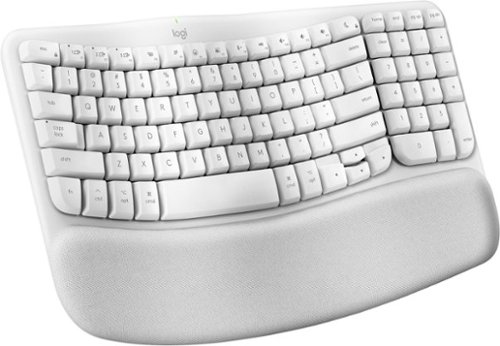
Logitech - Wave Keys for Mac Ergonomic Wireless Membrane Keyboard with Integrated Palm-rest - Off-white
Say hello to your first ergo keyboard, designed for Mac. Wave Keys for Mac wireless ergonomic keyboard is shaped for all-day comfort, with a wavy keyframe design for easy, natural typing. The cushioned palm rest with memory foam, provides 57% more wrist support. Pair Wave Keys for Mac with Lift for Mac for the full comfy experience.
Doubles down on Mac compatibility
Customer Rating
4.0
Posted by: bredeker
on July 5, 2024
The Wave Keys for Mac is a well-made keyboard with an interesting take on ergonomic design. Unless you're a die-hard fan of mechanical keyboards, you'll probably find it pleasant to use - especially so if you are accustomed to Apple's laptop keyboad layouts. Like the standard version, this "for Mac" version supports multiple devices, including non-Apples ones. Unfortunately, Logitech chose to limit the non-Apple device support with this version, which stands in contrast to how well they support all devices with the standard version. If this this limitation doesn't matter to you, then I can fully recommend this keyboard; read on for more details about why this is so.
This version of the Wave Keys keyboard is another entry in Logitech's series of "for Mac" product versions. I use the "for Mac" version of their MX Master 3S, and honestly, it was really little more than a different color. Like the mouse, the Wave Keys for Mac is not shipped with the compatible USB Bolt receiver and relies on Bluetooth connections. (Logitech does sell these separately if you want one.) But unlike the mouse, the Wave Keys for Mac actually does have some physical differences from the standard model to more closely match Apple keyboard conventions. Some of the differences from a standard PC keyboard are minor, such as renaming Backspace to Delete and Enter to Return. Others are more significant: Fn and Ctrl key positions are swapped, the number pad squeezes in an = key, and the Del key (forward delete) is replaced with a Mac-specific "Do Not Disturb" key that toggles the Mac OS focus mode. I personally see little value in this last change, and would prefer a traditional Del key - or at least a configurable function for it in the Logi Options+ companion software. (By the way, like a Mac laptop keyboard, Fn-Delete will work as forward delete.)
Another physical, albeit somewhat cosmetic change, is that Logitech removed the alternate Start and Alt legends from the Opt and Cmd keys, respectively. The Wave Keys for Mac is still a multi-device keyboard (meaning you can bind it to up to 3 computers and switch which binding is active with the F1, F2, and F3 keys), and it happily binds to non-Mac computers. However, the removal of the alternate legends may hint that this keyboard officially is not intended to support multiple operating systems. Unlike Logitech's normal keyboards, it doesn't seem like the key layout can be changed (to make the Cmd key function as Alt and the Opt key function as the Start/Windows key). The Logi Options+ companion software still has an option to keep the keyboard in Windows layout, but it just has no effect, whether connected via Bluetooth or a Bolt receiver. I also could not seem to get the layout to switch by long-pressing Fn-O or Fn-C as Logitech describes in their online support for the regular Wave Keys, so this might be a hard limitation of the keyboard. (It may yet turn out to be a firmware or Logi Options+ bug, though.) You can still use this keyboard with a PC, but you'll need to adjust to the remapped locations of Alt and Start if you do.
While I haven't used it for an extended period of time to judge the ergonomics more fully, I found the Wave Keys to be comfortable to type on. It did require a bit of an adjustment period, mostly in relearning where the Option key was (which I use heavily to move the cursor by a word at a time), but substantially less so than traditional ergonomic keyboards that split the keyboard. The keyboard feels solid enough for its price, though not quite on the level of Logitech's own higher end keyboards like the MX Keys and MX Mechanical (which I have also used).
I would recommend this to a friend!
0points
0out of 0found this review helpful.
Share this review:


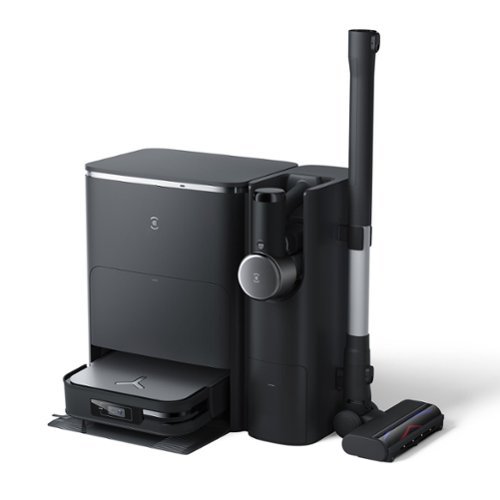
ECOVACS Robotics - DEEBOT X2 COMBO COMPLETE All-in-One Robot Vacuum & Spinning Auto Lift Mop with Cordless, Hand Held Vacuum - Black
ECOVACS DEEBOT X2 COMBO COMPLETE is the total package for whole home cleaning. This exclusive set combines the convenience of our cutting edge robot vacuum and mop with the go-everywhere capabilities of our cordless, hand-held stick vacuum. Both state-of-the-art cleaning tools are charged up and automatically emptied by the industry-first OMNI Docking Station so they stay ready to clean every inch of your home. For the most advanced clean, it doesn~t get better than DEEBOT X2 COMBO COMPLETE.
Robust and hassle-free cleaning, rough map editing
Customer Rating
4.0
Posted by: bredeker
on April 24, 2024
The Ecovacs Deebot X2 stands out for its cleaning effectiveness and self-prepping capabilities. This new combo edition adds a manual-use companion "stick vacuum" that charges from and empties to the same base station. The result is a complete package of convenient vacuuming equipment, all housed in a central station in your home. That is the vision Ecovacs seems to have for this product, at least, and for the most part they've delivered.
My initial impressions were mostly around the setup process and the base station itself. The product was packaged well, and the included quick start instructions were generally clear in describing assembly and placement requirements. (The manual does have an occasional "foreign" feel to it - for instance, the clearance requirements from nearby walls for placing the base station were quoted in both metric and U.S. customary units, but the latter was somewhat awkwardly specified in decimal quantity of feet. For instance, 0.16' instead of either 1.92" or 1 7/8".)
The base station is somewhat large, though not unreasonably so given the features it has. It requires notably less clearance from walls on either side than other robot vacuums that I've used required for theirs. The size of the station does mean some care is required when thinking about placement. To some degree, this negates the benefits of the device consolidation. It might seem like this product is a great fit for a small living space, but if you don't have a single large storage spot open (that is accessible for the robot to leave and come back to on a schedule), it might actually be better to have a separate stick vacuum charging stand with a smaller robot base station.
The actual functionality of the base station is quite nice. It auto-empties the dustbins from both vacuums. Even better, it auto-cleans the mop pads on the robot. Although you'll want to remove and launder the pads yourself periodically, it's nice that it'll keep refreshing them during a cleaning session. There's even a heated drying function built in. (We placed our station on a hardwood floor. I'm hoping the drying function doesn't have a bad interaction with the wood below it - so far, so good though.)
Neither the labeled instructions on the base station nor the quick start guide included mention of what cleaning solution, if any, should be added to the water reservoir in the base station. Ecovacs has a branded cleaning solution that claims compatibility with the Deebot X2 Omni, so the lack of mention of it is a little surprising. (No sample was included either.) In the end, I used a cleaning solution I already had that lists compatibility with other robot vacuums. I had to guess a little bit as to the proper ratio.
The included stick vacuum is straightforward and no-frills. It has a single high-/low-speed mode toggle. It performed acceptably, although it didn't sound or feel as powerful as the stand-alone vacuum we already have (from another brand). The quick start guide had no information about using it, so I guess it's good that it's pretty simple. The battery is non-replaceable, as far as I can see - time will tell how long of a lifetime it will have.
On first use, the Deebot X2 wants to map your home (which is typical for most advanced robot vacuums). It does this relatively quickly. However, this is also probably the functionality I found most disappointing. In our house, it failed to create any room boundaries automatically. (I would describe it as a semi-open floor plan, with two large doorways, one typical doorway, and no dividing wall in one location.) I'd be fine with that, if the manual map editing worked decently. Unfortunately, the map editing was frustrating. Most attempts to divide rooms failed, often with no reason (just "try again" phrasing). On occasion, it notified me that dividing lines can't intersect; at least that was a reason, but it makes me think it'd be completely impossible to partition the way we ideally would want it to. I was able to create a few divisions successfully but could never get them to line up with actual walls of the house - so we really ended up with 3 (rather than the 4 that we really have) arbitrary "rooms" that didn't correspond to areas a human would naturally think of. I deleted the map and retried the process several times, and got pretty much the same map with the same limitations on editing each time.
Ultimately, the inaccurate room divisions didn't cause any issues with the robot actually navigating our entire floor area successfully. The route planning seems a little inefficient, possibly because it sees one gigantic room. For instance, it cleans the perimeter of a "real" room before leaving to clean the central area of another that it thinks is part of the same "logical" room and then returning sometime later. This makes it a little awkward to avoid the robot when it's working, since it's not clear what rooms it's done with. However, the end result is still a decently cleaned floor - at least on par with other robot vacuums. The powered mopping pads seem like they must surely do a better job than other robot vacuums that only drag a mop pad over areas that they wet with cleaning solution. It was quite novel to see the robot return to its base a few times during the "whole house" job to clean its mopping pads automatically.
The X2 Combo isn't quite perfect, but it has some key features that make it a solid product. The vacuum performance is on par with competing robot vacuums that I've used. The killer feature is really the performance of the mopping feature, including the automatic preparation of it (cleaning, drying, and refilling with fresh cleaning solution). The Combo edition's included stick vacuum is decent - worth springing for if you need one or would like an auto-emptying feature, but perhaps not compelling if you have a vacuum you already really like. The only significant disappointment I had was with the map editing (the room division in particular). I'm hoping Ecovacs might improve it with future app updates, and that our floor plan is just a worst-case situation for it. Overall, I think it's a good product that most people will be happy with.
I would recommend this to a friend!
0points
0out of 0found this review helpful.
Share this review:


bredeker's Questions
bredeker has not submitted any questions.
bredeker's Answers
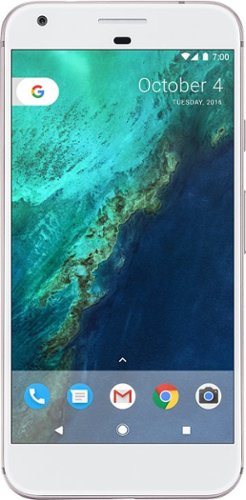
Google - Pixel XL 32GB (Verizon)
Add high-end performance to your everyday life with the Google Pixel XL. A quad-core processor, a 5.5-inch LED screen and 32GB of memory ensure this phone is able to handle daily life, and Corning Gorilla Glass 4 protects the screen. Easy cloud storage ensures you never run out of space on the Google Pixel XL.
Can u transfer ur songs and photo from ur iPhone to this kind of phone
Yes, the setup wizard lets you do this for songs, videos, photos, and more. (You can limit what you all transfer if you prefer.) I had a few music albums that did not transfer as readable files, but for the most part it worked well. It also kept most of my text message/iMessage history. You will need to turn off encrypted backups to let the Pixel have access to some of this stuff, but the setup process tells you how to do that if needed.
9 years, 10 months ago
by
Posted by:
bredeker

Microsoft - Surface Pro 2 - 256GB - Dark Titanium
Microsoft Surface Pro 2 Tablet: More capable than your average tablet but lighter and smaller than a laptop, the Surface Pro 2 features hands-on productivity with the ability to fully support Microsoft Office (sold separately). Multitask with side-by-side apps, prop up your tablet with the built-in kickstand, or connect accessories via the USB and display ports for a work-efficient desktop setup.
When will 256Gb version be available again? As of 05 Feb 2014 not available at Best Buy.
I noticed as of today (05 Feb 2014) that the 256Gb Surface Pro 2 is unavailable at the moment at Best Buy. Any word on when the new ones will roll out? And, will they be equipped with the newer i5-4300u processor (1.9GHz)?
Supply of these still seems to be constrained from Microsoft, so Best Buy is apparently only taking online orders for them yet (at least, none of the brick-and-mortar stores near me have shown availability). Best Buy periodically gets new stock in, so all I can say is keep checking. When they do come in, they sell out fast too. I was lucky enough to get an order in the second time that I saw stock available in January 2014. I can confirm that mine came with the new i5-4300U.
12 years, 7 months ago
by
Posted by:
bredeker
from
WI
Microsoft - Surface Pro 2 - 256GB - Dark Titanium
Microsoft Surface Pro 2 Tablet: More capable than your average tablet but lighter and smaller than a laptop, the Surface Pro 2 features hands-on productivity with the ability to fully support Microsoft Office (sold separately). Multitask with side-by-side apps, prop up your tablet with the built-in kickstand, or connect accessories via the USB and display ports for a work-efficient desktop setup.
does this Surface pro 2 256gb ssd 8Gb ram have the new Haswell processor in it ?
does this Surface pro 2 256gb ssd 8Gb ram have the new Haswell processor in it ?
or is this a older model that was in storage ?
cause in the past 2 months they updated the surface pro with the haswell processor .
I wasw wondering it if was the haswell processor is it the quad core one for dual core one ?
or is this a older model that was in storage ?
cause in the past 2 months they updated the surface pro with the haswell processor .
I wasw wondering it if was the haswell processor is it the quad core one for dual core one ?
The Surface Pro 2 models, including the 256 GB/8 GB model, all have dual-core mobile Haswell i5 CPUs. The first ones shipped with Core i5-4200U processors, but around the December 2013 timeframe Microsoft started making them with faster Core i5-4300U processors instead for the same price. If you order a new one it will most likely come with the newer, faster CPU.
12 years, 7 months ago
by
Posted by:
bredeker
from
WI
Microsoft - Surface Pro 2 - 256GB - Dark Titanium
Microsoft Surface Pro 2 Tablet: More capable than your average tablet but lighter and smaller than a laptop, the Surface Pro 2 features hands-on productivity with the ability to fully support Microsoft Office (sold separately). Multitask with side-by-side apps, prop up your tablet with the built-in kickstand, or connect accessories via the USB and display ports for a work-efficient desktop setup.
can this unit run adobe photoshop cc.exe not the metro app version ?
can this unit run adobe photoshop cc.exe not the metro app version ?
metro apps are useless when it comes to features and power use.
the real photoshop CC version is not an app and hogs a lot of memory when running on any pc even desktops.
so can this handle the real program of photoshop CC ?
metro apps are useless when it comes to features and power use.
the real photoshop CC version is not an app and hogs a lot of memory when running on any pc even desktops.
so can this handle the real program of photoshop CC ?
I haven't tried Photoshop personally, but you can install and run it since the Surface Pro has full-blown Windows 8 Pro and you can install any Windows application on it that you want. (Only the cheaper non-Pro Surfaces with Windows RT are limited to "Modern UI" apps from the Windows Store.) If you get the 256 GB or 512 GB Surface Pro 2 it will have 8 GB of RAM instead of 4 GB, and they all have fast flash memory for scratch file storage, so I expect Photoshop will run decently as long as you're not expecting workstation-class performance.
The artist for the Penny Arcade Internet comic strip has started to use a Surface Pro on occasion to draw the strip, and uses Adobe Creative Cloud programs on it. Search for "Penny Arcade Surface Pro" to get his take on it. (That was also for the older and slower first-gen Surface Pro.)
The artist for the Penny Arcade Internet comic strip has started to use a Surface Pro on occasion to draw the strip, and uses Adobe Creative Cloud programs on it. Search for "Penny Arcade Surface Pro" to get his take on it. (That was also for the older and slower first-gen Surface Pro.)
12 years, 7 months ago
by
Posted by:
bredeker
from
WI